The legal address in Uzbekistan: cadastre numbers, what the registry accepts, and what fails

An Uzbek company’s address is checked against the state’s own property records before it is registered — and an address the state cannot find is a ground for refusing the company outright. What the registry actually looks for, why virtual offices fail, and what changing an address later costs.
Most jurisdictions take a company’s registered address on trust and deal with the consequences afterwards. Uzbekistan does not. The address a company states in its founding documents is checked against the databases of the tax and cadastre authorities while the filing is being processed, and its absence from them is one of the enumerated grounds on which registration is refused (the registration regulation, para. 40). Not queried, not flagged for later — refused.
That single sentence in the act is why the address is the step at which more first filings by foreign founders fail than any other. It turns an administrative detail into a document problem that has to be solved before anything else can proceed, and it is the reason a forwarding address, a co-working membership or a friend’s spare room will not do.
What the registry actually checks
The regulation is narrower than people expect, and reading it precisely matters. It does not say the premises must be suitable for the business, that they must be commercial, or that anybody will visit them. It says the address information stated in the founding documents must be present in the databases of the tax and cadastre authorities. The registrar is asking one question — does the state already know about this address? — and refusing where the answer is no (para. 40).
It is a machine question, and it is answered by machine. The registration System matches the filing against the state databases and registers where the two agree; the disqualifying circumstances are established by integrating the tax, interior, health, court and economic-crime systems into it rather than by an officer reading anything (paras. 16 and 401). Nothing about the check is negotiable, because there is nobody in the loop to negotiate with.
The cadastre number
A cadastre number is the state property register’s identifier for a specific piece of real estate. It attaches to premises, not to a person or a company, and it is what makes an address a record rather than a description. Premises that have one exist in law; premises that do not are an assertion, however solid the building.
On the portal this is visible immediately. The location step does not want an address written out in words — it wants the number, and it fills in the region, district, mahalla and street itself from it. The applicant says only whether the premises are owned or rented, and a banner on the screen puts the liability for a false registration address on the applicant.
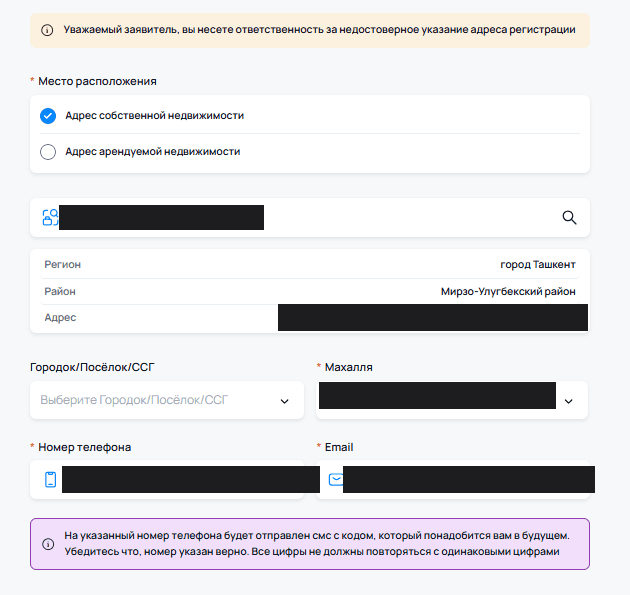
This is where a virtual office fails, and it fails early: there is no number to enter. A mail-handling service that cannot give a cadastre number for premises it can put a company into is not offering a registered address in the sense the registry uses the term, whatever it is called.
The three shapes an address can take
The application form itself offers only two, and the third is a variety of the second. A company may be registered at the address of one of its founders, identified by that founder’s tax number; or at another address, chosen from the state address directory (para. 9, and the application form at appendix 5).
- A founder’s own address. Clean where a founder is resident in Uzbekistan and holds property there. For a foreign founder it is usually unavailable — the address has to be an Uzbek one in the state’s records.
- Premises the company owns. The company buys or already holds the property, and the cadastre number is its own. Rare at incorporation, and it inverts the ordering problem: the company has to exist before it can buy.
- Leased premises. The ordinary answer, and the one that carries the conditions. What the registry needs is the cadastre number of premises the company has a right to occupy; what a landlord has to be willing to do is let their property’s number be used and the lease be registered.
The lease is not an afterthought filed later. Executing a real-estate lease and registering it with the tax authorities is one of the composite services the registration request itself can trigger, alongside the tax regime, the digital signature, the bank account application and the licence notification (para. 9). Whoever is assembling the filing should know before it starts whether the lease is going through it or separately.
The rent the tax authority assumes you pay
A registered lease brings a second rule with it, and it is the one that surprises people who negotiated a favour rather than a market rent. Uzbekistan sets a statutory minimum rent per square metre for tax purposes: where the contract rent is below it, tax is computed on the minimum rather than on what was actually agreed. A nominal lease from an obliging landlord therefore does not produce a nominal tax base. These are the 2026 rates.
| Where | Residential | Non-residential | 18 m² at the floor |
|---|---|---|---|
| Tashkent | 30,000 | 48,000 | $69864,000 UZS |
| Nukus and regional centres | 14,500 | 28,400 | $41511,200 UZS |
| Other settlements | 5,900 | 11,800 | $17212,400 UZS |
The practical reading is that the address has a floor cost even when the rent does not, and that the floor is set by where the premises are. It is worth pricing before choosing a district, not after signing.
The address is public
Once registered, the address is on the record for anyone to read. The Unified State Register’s content list holds the company’s location alongside its name, legal form, tax number, the composition of its founders, each founder’s share and the founding documents themselves; the register is open to any interested person, sits on the single portal, and is updated daily as entries are made (the register regulation, paras. 5, 11 and 12).
For a founder using their own home as the company’s address, that is worth pausing on: it is a residential address published on a state register, findable by anyone who looks the company up, including counterparties and anyone with a grievance. It is a common reason to take a commercial address even where a home one would technically pass.
Changing the address later
A change of a legal entity’s location or postal address must be filed within ten days of the change — the shortest of the re-registration deadlines, against thirty days for changes to the founding documents, thirty for a change in a founder’s share and thirty for a reorganisation (para. 21). The clock runs from the move, not from when anyone gets round to the filing.
The act then makes the address change lighter than other re-registrations, and conditions the lightness on tax standing. Changes on a change of location are entered by way of notification to the registering body where the company has no tax debt exceeding three hundred times the base calculation value (para. 21). Above that, it is a full re-registration.
A new address is checked exactly as the first one was — it has to be in the tax and cadastre databases, or the change is refused on the same ground (para. 40). Once it goes through, the System notifies the registering bodies, the authorised organisations and the state administration bodies of the new address itself, so the company does not repeat the news to each of them (para. 6).
A branch’s address, and its own ten days
A company that opens a branch or representative office notifies a Public Services Centre within ten days of creating it, attaching the minutes resolving to create it and the branch’s charter, both in the state language. The service is free and takes two working hours. A later change to the branch’s postal address is its own ten-day notification (the branch regulation, paras. 3, 7, 8, 10 and 14).
That regulation is written for the branches of Uzbek business entities. Its opening paragraph excludes the branches and representative offices of foreign commercial organisations, so a foreign company reading about a two-hour notification is reading about a different case than its own (para. 1).
What to have before you file
- The cadastre number of the premises, from the owner — not the address in words.
- A landlord who will let that number be used for a company registration, and who understands the lease may be registered with the tax authorities.
- A rent figure checked against the statutory minimum for the district, so the tax base is not a surprise.
- A decision about whether a founder’s residential address is acceptable on a public register.
- Clean tax standing if this is a change rather than a first registration — under 50 BCV to make the change at all, under 300 BCV to make it by notification.
None of that is difficult. All of it is slow to fix once a filing has been refused and the duty spent, which is the whole argument for settling the address before anything else in the file.
Base fee from $450, published modifiers, no travel. The form prices your exact setup in two minutes.