How to open a company in Uzbekistan as a foreigner — registration, taxes and what you file afterwards

Uzbekistan registers companies through one state portal, and the state’s own part of it is measured in hours, not weeks. Every identity gate in that portal assumes you are Uzbek. This is the whole thing end to end — the procedure screen by screen, where a foreign founder has to step outside it, which tax regime you are choosing without noticing, and what the company files from the day it exists.
What you are registering
The entity most foreign founders want is the mas’uliyati cheklangan jamiyat — MChJ in Uzbek, OOO in Russian, limited liability company in English. All three names go into the charter and all three are the company’s name: the registry records the Latin Uzbek form, and the bank, the tax filings and the invoices each lean on a different one.
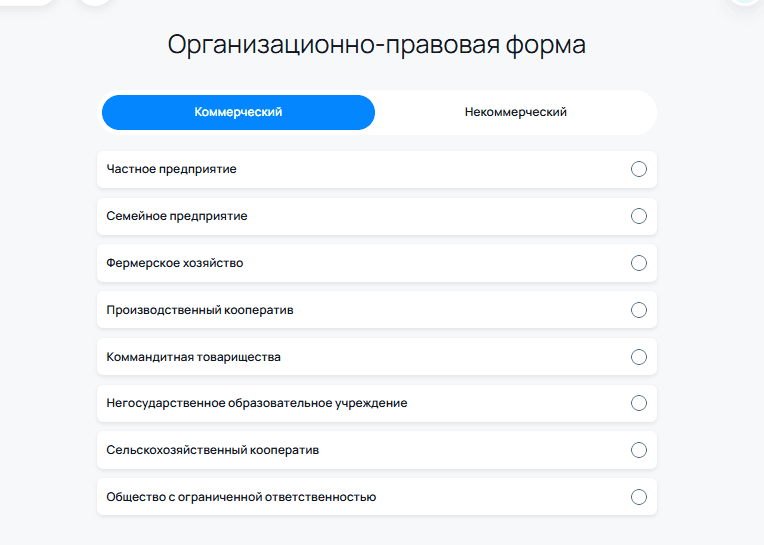
It is one of eight commercial legal forms the portal offers. A foreign individual or a foreign company may hold 100% of the charter capital — there is no local-partner requirement and no nationality condition. The company becomes a legal person on the day the registry enters it, not on the day the charter is signed.
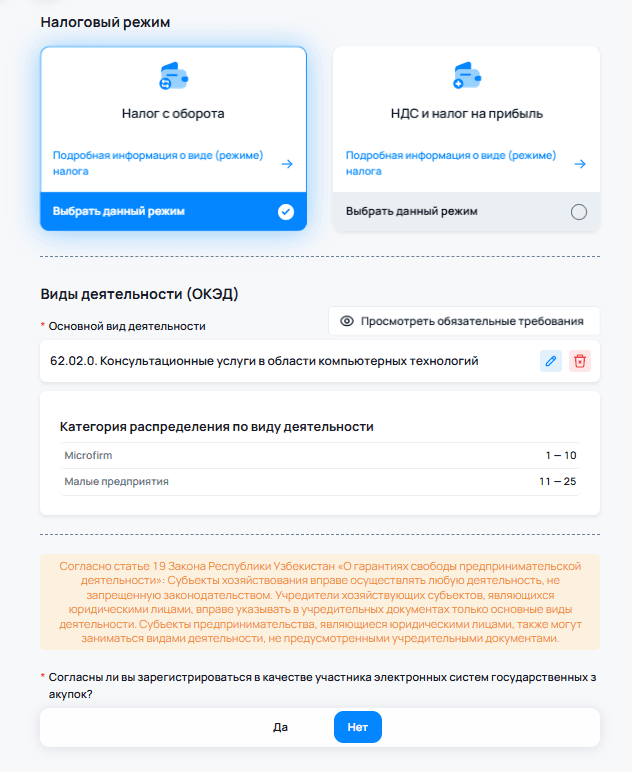
One thing surprises almost everyone: the activity code you choose does not limit what the company may do. The portal says so on its own screen, quoting Article 19 of the Law “On Guarantees of Freedom of Entrepreneurial Activity” — a business may carry on any activity not prohibited by law, and a legal entity may carry on activities its founding documents never mention. The OKED code is a registry label, not a permission. What does gate you is licensing.
The registration is one online form
Registration runs through the state’s single window for business registration, part of the unified portal of interactive government services. You choose between registering without forming a legal entity — a sole trader — and with one; you pick the legal form; then you check the name.
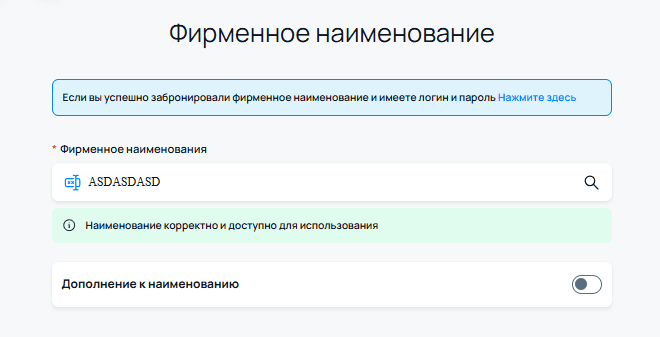
The name check is live and strict about one thing: Latin script. Type a name and the portal answers immediately whether it is correct and available, and there is an optional “addition to the name” field for a descriptor. A taken name surfaces in seconds rather than after filing, which is why it pays to arrive with a ranked list rather than one favourite.
Once the name clears, an application opens under its own number, with nine numbered steps:
- 01 · Applicant — who is filing, and under what authority
- 02 · Location — the cadastre number of the premises
- 03 · Activity — the tax regime, and the OKED activity code
- 04 · Founding data — capital, headcount, founders, beneficial owners
- 05 · Director — the person who will run it
- 06 · Data check — the charter, and every consent
- 07 · Payment — the state fee
- 08 · Review — the registry decides
- 09 · Bank account — a request routed to a bank you choose
Steps 01 to 06 are yours to fill in. 07 to 09 happen to you.
What the six steps actually ask
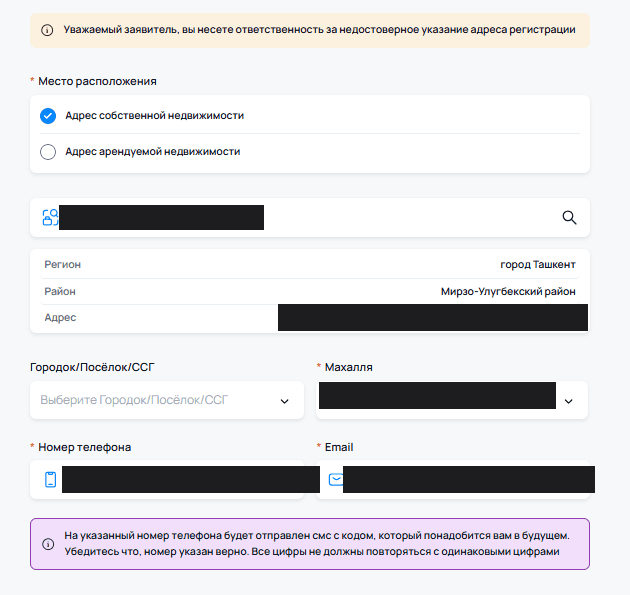
Location does not want an address in words. It wants the cadastre number of the premises — the state property register’s identifier — and fills in the region, district, mahalla and street itself from that number; you only say whether the premises are owned or rented. A banner on the screen states that the applicant carries the liability for a false registration address. This is the step at which a virtual office fails: there is no cadastre number to type. The portal is not being fussy. The absence, from the databases of the tax and cadastre authorities, of the address a company gives in its founding documents is one of the enumerated grounds on which registration is refused (the registration regulation, para. 40).
Activity puts two decisions on one screen, and the first is the expensive one. You choose the tax regime at registration — turnover tax, or VAT plus profit tax — and then pick the OKED activity from a tree. The portal shows the size band that activity implies (for computer consulting, 62.02.0, a microfirm is 1–10 employees and a small enterprise 11–25) and asks whether you want to be registered as a participant in the state electronic procurement system. A company that will not bid for state contracts answers no; it can be added later.
Founding data collects the capital currency, the headcount — at least one, since the company has a director from day one — then each founder, then the beneficial owners. A founder is added by identity document and personal identification number: the portal looks the person up in the state population register and fills in their name, sex and date of birth. You type only the contribution; the percentage is computed from it.
The Law on Limited Liability Companies sets no minimum charter capital, and for ordinary activities nothing else imposes one: you choose the figure and contribute it in money. Some licensed activities do carry a minimum, and those are outside this procedure anyway.
The beneficial-owner questionnaire is not conditional — it is answered on every filing. Four questions on whether the beneficiary, their close relatives or their friends are senior public officials, and two on whether they operate accounts in the interests of third parties. A “yes” to any of them has to be explained in writing in the box underneath.
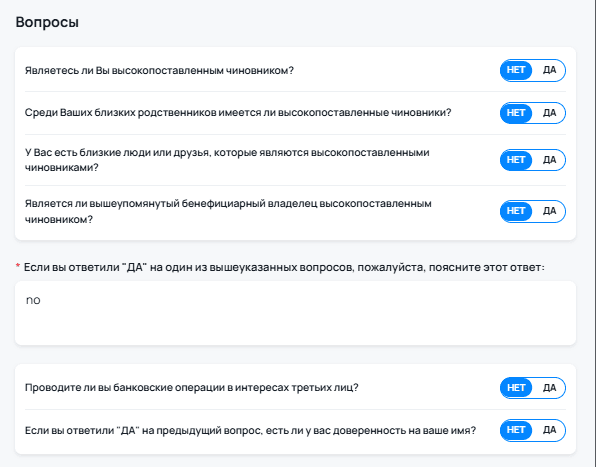
Director is the same lookup once more: document type, number, identification number, and the register supplies the rest.
Where a foreign founder falls out of it
Step 06 is where the application stops being data entry. The portal generates a charter, and then every founder and the director must each consent separately, from their own account on the portal — a QR code and a link, a status reading “awaiting”, and a confirmation that is a live camera check against the biometric record the state already holds.
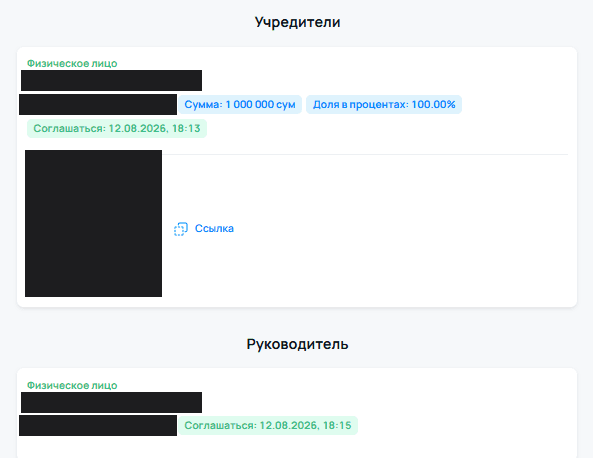
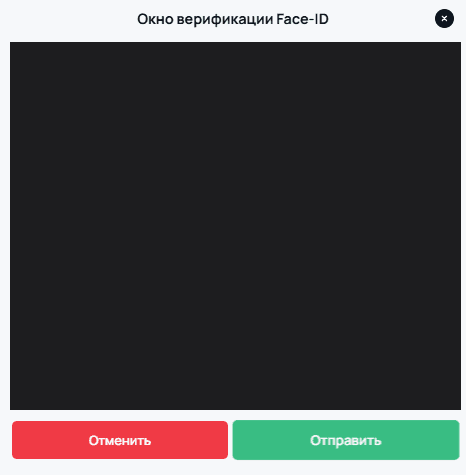
Now count the identity gates in the whole flow. The applicant is identified by a personal identification number. Each founder is looked up by one. The director is looked up by one. And each of them confirms with their face. A founder who has never been to Uzbekistan has none of that — no identification number, no biometric record, and no account on the portal for a consent request to arrive in.
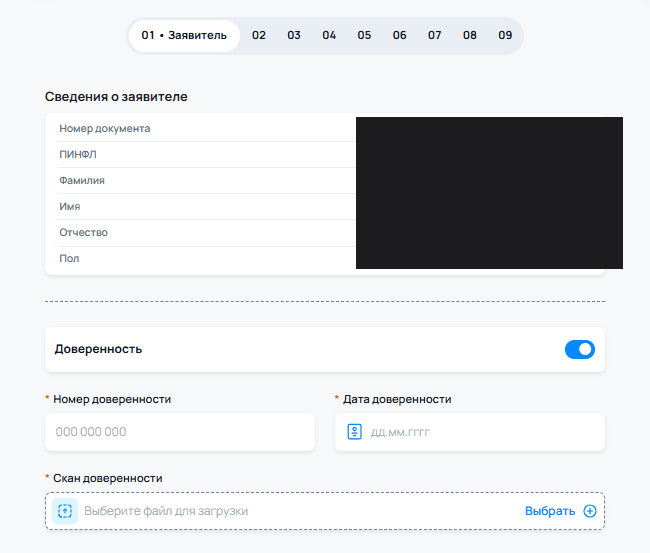
So the sequence is not the one the portal implies. Either the shareholders obtain Uzbek identification numbers and electronic signatures of their own and file it themselves, or — far more commonly — somebody in Uzbekistan holds a power of attorney and files it for them. That is what the “power of attorney” toggle on step 01 exists for: switch it on and the applicant declares the instrument’s number and date and uploads a scan. From then on the representative is the person the portal identifies, and the representative’s own face is what passes the biometric check. You are the person the paperwork identifies.
Identification numbers and electronic signatures
The personal identification number — PINFL — is the thing the registry, the tax office and the bank record every shareholder and the director by. A foreigner has three ways to get one.
- In person, at the district office of a State Services Centre, with a passport and a registration. It is a short application and it is normally issued in about five minutes.
- At an Uzbek consulate, in most countries where there is one — the way to get it without travelling.
- Through a representative, under a power of attorney that expressly carries the power to obtain a PINFL on your behalf.
Electronic signatures come in two layers, and conflating them is a common source of confusion. The first layer is personal: an individual signature belonging to whoever approves the filing — each shareholder, if they are filing for themselves, or the representative, whose signature initiates the incorporation when they are acting under a power of attorney. The second layer belongs to the company itself, is obtained by the director once the company exists, and is what the company signs its filings and bank instructions with afterwards. The first gets you registered; the second lets you operate.
The power of attorney, and the three routes it can travel
State registration takes about sixteen hours through the portal. A power of attorney takes one to three weeks, and it is the only step in the whole procedure that nobody can do on a founder’s behalf.
What it has to authorise is a good deal more than “register my company”. A workable instrument names the bodies the representative may appear before — the state services centres under the Ministry of Justice, the tax and law-enforcement authorities, banks, courts, the stamp-engraving workshops — and then lists the acts: obtain a personal identification number; obtain an electronic signature and go on using it; decide, sign, file and collect the founding minutes, the charter and the foundation agreement; sign the director’s employment contract; pay the state fees and duties; and open and operate the bank account. Powers left out are powers the representative does not have, and each omission is a second visit to the notary.
Then it has to survive the journey. Three routes, decided by the country it is signed in rather than by the document:
- Minsk / Kishinev convention states — most of the CIS. A notarised original drawn up in Russian is accepted as it stands: no apostille, no consulate, no translator.
- Hague Apostille countries — the EU, the UK, the US and most of the rest. Notarisation, then an apostille, then a certified translation into Russian or Uzbek. The convention has been in force for Uzbekistan since 15 April 2012.
- Everywhere else — notarisation, then consular legalisation through an Uzbek embassy, then translation.
The documents you actually need
For a single individual founder the list is shorter than most people expect.
- A passport — a clean colour scan. It is not apostilled: legalisation attaches to document type, and a passport is not one of the types that gets legalised.
- A power of attorney, notarised and legalised on the route for the country it is signed in — unless the founder is filing personally with their own identification number and signature.
- The company name in Latin script, with fallbacks ranked in order.
- The cadastre number of the registered address.
- The charter capital figure and — with more than one founder — the split, in percentages and in amounts.
- A description of the business in plain prose. This is not the OKED code, and the bank will ask for the same text later.
A corporate founder adds two documents: the registry extract or certificate of incorporation, and proof that whoever signs for it is entitled to. Both are legalised on the same route as the power of attorney and translated into Russian or Uzbek.
Two constraints on the form of that bundle are worth knowing before anything is scanned. The founding documents reach the registrar in the state language, and every document goes in as its own file — an electronic document, or a PDF scan of a paper original at not less than 200 dots per inch and no larger than 10 megabytes (paras. 12 and 13 of the registration regulation). A properly apostilled set scanned as one oversized file is a filing that fails on its packaging rather than on its substance.
The charter the system writes, and the one you may want
Step 06 gives you both options and it is easy to miss. The portal generates a charter — a .docx and a .pdf, both named after the application number — and puts an upload slot directly beneath it for a charter of your own. Either will register.
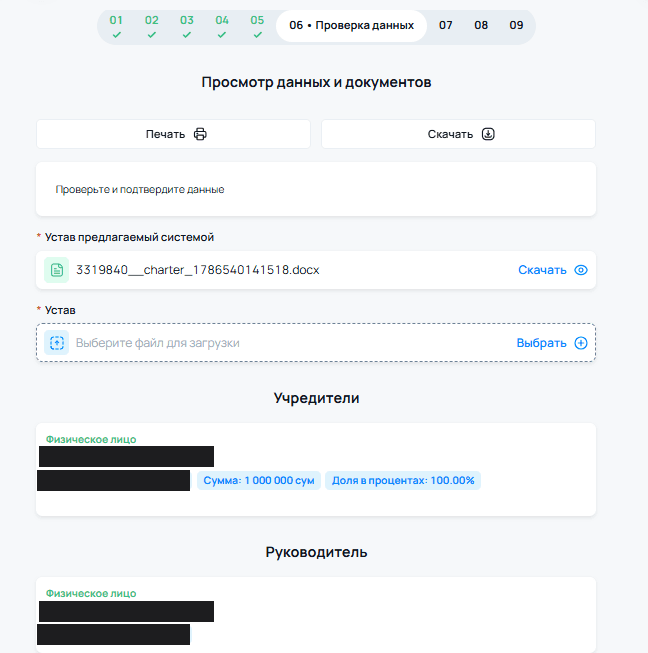
The generated charter is very basic. It is a valid document and it will not be argued with, but it is written to the statutory minimum and does not address the things a multi-owner or foreign-owned company usually wants addressed — how decisions are taken and at what majority, what happens when a participant wants out, how a deadlock is broken, what a new participant may be admitted on. None of that is illegal to leave out. It simply means the default rules apply, and the default rules were not written with your cap table in mind.
Charters used for foreign-owned companies also tend to run bilingually, article by article, with English beside the Uzbek or Russian so the owner can read what they are signing without a translator at their elbow. The founding minutes do the same, down to writing the capital out in words in both languages: “51 687 720,00 (Fifty-one million six hundred eighty-seven thousand seven hundred twenty,00) soums”.
Two details in those minutes matter later. Each founder’s share is recorded as a percentage and as a nominal amount, and it is the amounts that must reconcile to the capital exactly — three equal founders produce 33.33 / 33.34 / 33.33 against three identical amounts, so a document checked percentage-by-percentage would be rejected for being right. And the meeting elects the director. Minutes without that resolution leave the company with no director on record from the day it exists.
What the state charges
Everything the state charges is denominated in multiples of the base calculation value — the BCV — rather than in som, so the figures move when the BCV is raised by decree rather than when a fee schedule is rewritten. Multiply by the BCV in force on the day you file.
The registration duty itself is 1× the BCV for a business entity registering at a State Services Centre, under the state duty rates (the schedule). That is the headline fee and the only one set there. The rest sit in their own acts and tariffs: the state services fee at 0.5×, and the electronic signature at 0.07× for an individual and 0.1× for a company — the signature being priced by the tax committee under its own published offer rather than by a duty schedule. A personal identification number carries no fee at all.
You do not have to look the duty up. The System computes the rate itself once the request is complete, and offers three ways to pay it: a card in real time, cash or transfer at a bank counter against the request’s unique number, or a transfer from a settlement account. Paying electronically costs a further one per cent of the sum in commission. Whatever is paid is not returned — the regulation says so on payment and again among the refusal provisions, excepting only sums overpaid, so a filing refused for a missing document has still spent its duty (paras. 5, 14 and 48).
The second cost is the one incurred at home and it is usually the larger of the two: notarisation, apostille or consular legalisation, and certified translation, which run from about $150 to $600 depending on the country and the number of shareholders signing. Nothing about that is payable in Uzbekistan and nobody in Uzbekistan can reduce it.
If you use a provider rather than filing yourself, their fee is a third cost on top of both. Ours is published, with its modifiers, on the pricing page.
The honest timeline
The state’s own step is fast, and how fast depends on how you file. The regulation sets one deadline — in real time, and not more than thirty minutes once a complete request has been filed and the duty paid (the registration regulation, para. 16 and appendix 3). In person at a State Services Centre that half hour is what happens. Filed online through the portal, the same procedure comes back in about sixteen hours — and the portal is the route a founder abroad uses. The realistic total is still three to five weeks, and the difference is almost entirely the power of attorney.
- Weeks 1–3 — notary, apostille or consulate, courier — the founder’s own steps
- +1–2 days — personal identification numbers for the founders and the director
- +16 hours — state registration, filed online
- +1 day — the company’s electronic signature
- +1–3 days — the bank account, after the visit
The name check, the charter and the activity description can all be prepared during the first row. Nothing after it can start until the original instrument is physically in hand — which is why the single most useful thing to do first is start the power of attorney and worry about the rest afterwards.
The bank account
The application’s ninth step is called “bank account”, and it is available to any company registering through the portal.
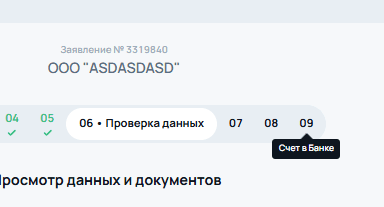
It is worth being precise about what it does, because the label oversells it. Onboarding is not digital. The step sends a request to a bank you choose; the bank then contacts you and assigns a time for someone to come in. What follows is the bank’s own procedure, unchanged.
And that procedure requires the director to identify in person before a corporate account opens. This is the one physical appearance in the whole process, and it is what quietly breaks “fully remote” offers made by providers with nobody on the ground: the company registers cleanly and then the account does not open. A foreign founder either appoints a director who will travel, or appoints one who is already there.
The tax regime you chose at step 03
The registration form asks which tax regime the company will be on, and most founders answer it in a few seconds without realising it is the largest financial decision in the whole filing. Uzbekistan runs two, and they are not variations on each other — one taxes revenue and the other taxes margin.
- Turnover tax — 4% of total income (Tax Code, Art. 467), with no deduction for what the business spent. Available while total income stays under 1,000,000,000 UZS a year (Art. 461). Retail trade is rated by where it happens rather than at a flat 4%.
- VAT and profit tax — 12% and 15% (Arts. 258 and 337). VAT is charged on sales and reclaimed on purchases; profit tax falls on what is left after costs. More filing, more bookkeeping, and deductions that turnover tax does not give you.
Which is cheaper is a question about margin, not about size. A business with thin margins and heavy costs can pay more under 4% of revenue than under 12% plus 15% of profit; a business with almost no costs pays far less. Work it out on your own numbers before the form asks.
The choice is not permanent. A company crossing the threshold moves to the general regime, and one that wants the general regime can elect it. But the switch has its own timing and its own registration step, so it is far cheaper to answer step 03 deliberately than to correct it afterwards.
After registration: what starts on day one
The company exists from the registry’s entry, and so do its obligations. There is no grace month, and nothing waits for revenue.
| Filing | Period | Deadline | Payment |
|---|---|---|---|
| VAT | month | 20th of the following month | with the return |
| Profit tax | quarter | 20th of the month after the quarter | advances by the 23rd monthly |
| Profit tax — annual | year | 1 March | with the return |
| Personal income tax | month | 15th of the following month | with the return |
| Personal income tax — annual | year | 15 February | — |
| Employer notification | year | 25 January | — |
| Social tax | month | 15th of the following month | with the return |
| Social tax — annual | year | 15 February | — |
| Turnover tax | month | 15th of the following month | with the return |
| Turnover tax — annual | year | 15 February | — |
Which rows apply depends on the regime chosen back at step 03, but the shape does not change: monthly returns on the 15th and the 20th, quarterly profit tax with monthly advances on the 23rd, and an annual cluster between January and March. Payroll adds 12% personal income tax withheld from the employee (Art. 381–382) and 12% social tax paid by the company (Art. 405). Everything is filed through the electronic cabinet, in Uzbek or Russian.
Three things become standing monthly costs the moment the company exists, whether they are hired locally or bought as a service: a director, who answers personally for what the company files and pays; a registered address, which has to keep passing the same two checks it passed at registration; and someone who can file in the original language. A first-year budget that counts only the registration is short by the larger number — see the pricing page for what those three cost here.
Missing a filing is cheap once and expensive as a habit. A late return is an administrative fine on the company’s official rather than on the company (Administrative Liability Code, Art. 175) — the Tax Code sets no figure for filing late and stops at making the official liable (Tax Code, Art. 220). Paying late is different in kind: interest at one three-hundredth of the Central Bank refinancing rate for every calendar day the tax is outstanding, with no stated cap (Art. 110). The tax calendar carries every deadline and what each one costs.
The company will also need a bank account before it can do very much, and that is a shorter procedure than most founders expect — three documents and, on the act’s clock, the next working day. And if you are still deciding whether Uzbekistan is the right market at all, the economy and banking figures are the numbers that decision rests on.
Base fee from $450, published modifiers, no travel. The form prices your exact setup in two minutes.